Interfaces are getting good at producing more: more answers, more states, more explanations.
Our attention hasn’t grown with them. At Sirion I watched one contract field go from having one thing to say to having seven. It made me wonder whether the better question is less about how much an interface can show, and more about how much a given moment needs.
Sensitivity is my working idea for that: judge how much the moment asks for, then use as little interface as it takes. It’s still a sketch. The specimens below are where I’m trying it out.
A renewal is a week away, and the notice period has changed three times since signing.
Amendment No. 3 · Renewal & Terms1 of 4
“Either party may terminate this Agreement, in whole or in part,
for convenience on ninety (90)
daysprior written notice to the other party.
Termination under this Section does not relieve either party of any obligation
accrued before the effective date of termination.”
§14.1 · 31 March 2026
Preview
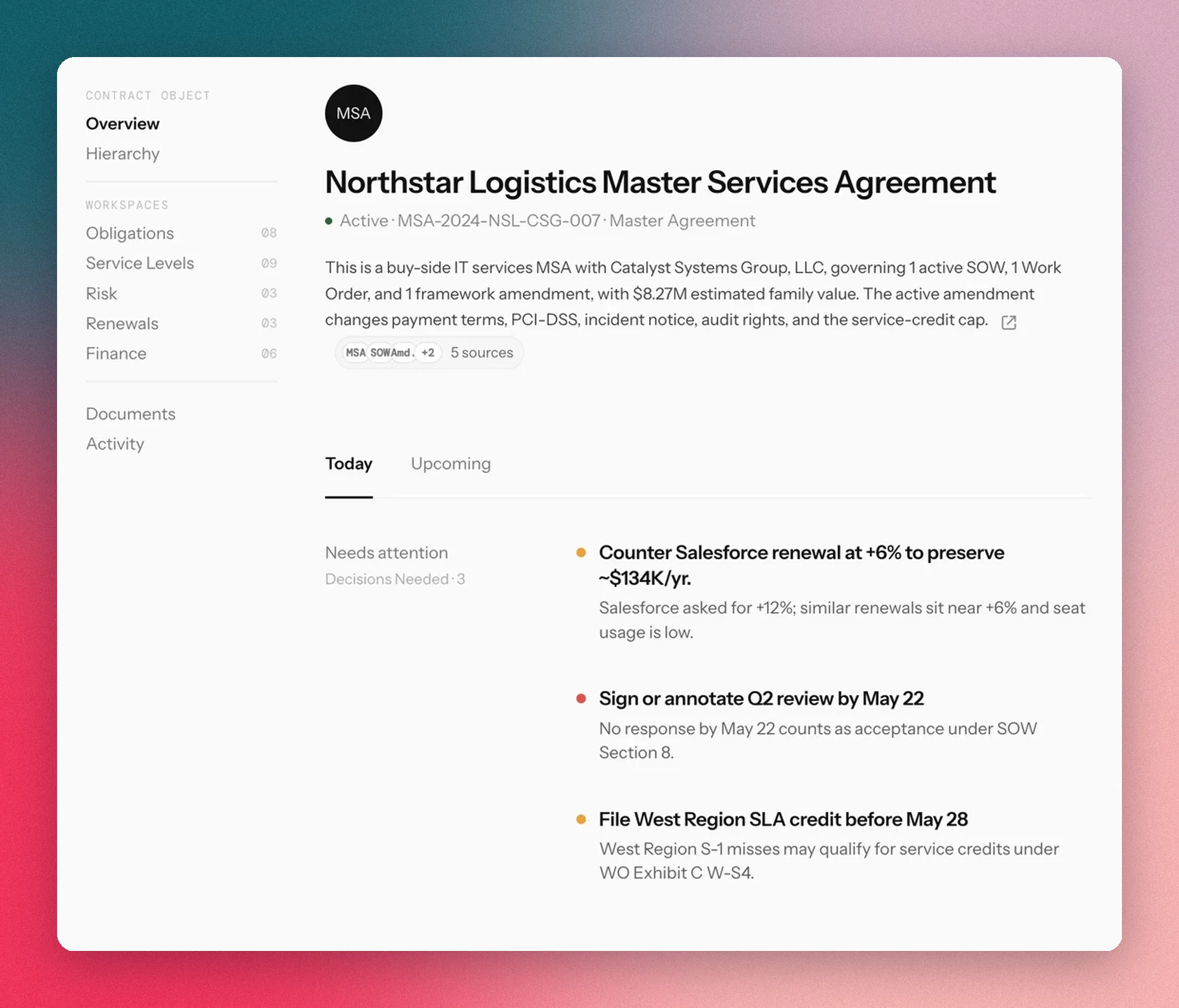
A vendor asks for 12% more at renewal. The agent suggests countering at 6%.
Counter the renewal at +6%
Their ask sits above comparable renewals and usage is low.Vendor requested +12%, submitted 4 March. Comparable renewals in segment: +5.4% median, n=38. Seat utilisation 61% trailing 90 days, down from 78%.
Vendor requested +12%, submitted 4 March. Comparable renewals in segment: +5.4% median, n=38. Seat utilisation 61% trailing 90 days, down from 78%. Prior renewal +9%, accepted without counter. Contract permits 30-day notice. Three similar accounts countered at +6%, +5%, +7%. Model confidence 0.81. Suggested next step: draft counter. Alternative: request usage-based tier. Related obligations: 2. Escalation path: category lead.
Expand
An agent renaming your files stops halfway, because six of them need admin access.
Your admin sees the six files and the reason.
Expand
An agent has drafted an update to 42 customers, and it goes out at 4 PM.
It goes at 4:00 PM and cannot be recalled after that.
EMEA18Americas15APAC9
Shipped · 12in the digest, in merge orderMoved · 3re-dated to Thursday next weekBlocked · 1the SSO migration, waiting on the vendor
Preview
You ask to share a draft with Alex, and there are two of them.
Which Alex gets the draft?
Whoever you pick can open it and comment.
Transform
You’re back after a day off, and all you need to know is whether the deadline moved.
18 unread messages
“Can we push to Friday?”Priya · Tue 14:02“Monday works better for us.”Sam · Tue 16:40“Friday it is, then.”Dev · Wed 09:15The other fifteen say nothing about the deadline.
Transform
An amendment changed the liability cap. What was it before?
Liability cap · $2,000,000
Transform
The AI has read the payment term, but it isn’t fully sure.
Payment term · Net-45
0.82 confidenceread from §7.2read from §7.2
Expand
If you don’t respond by the 22nd, the review counts as accepted.
Sign or annotate the review
No response by the 22nd counts as acceptance.
Give instruction
Preview
You searched for “Europe”, but you might mean the EU only, or EMEA.
Understood as
RiskHigh
Region
Open
Before deciding how the interface responds, decide how much attention
the moment deserves.
Then use the least interface that makes it clear.Increase expression only as far as understanding requires. Behind this line, the reasoning on one page: what Sensitivity is, how it works, why it matters now.
A longer write-up, ten screens with fuller notes behind them: how an agent might read a situation, the five levels, and the places where the idea doesn’t hold up yet.
When AI knows the answer, how does it know when to speak?
How I think · Own work · 2023–26
The same information can mean something very different depending on when it reaches you.
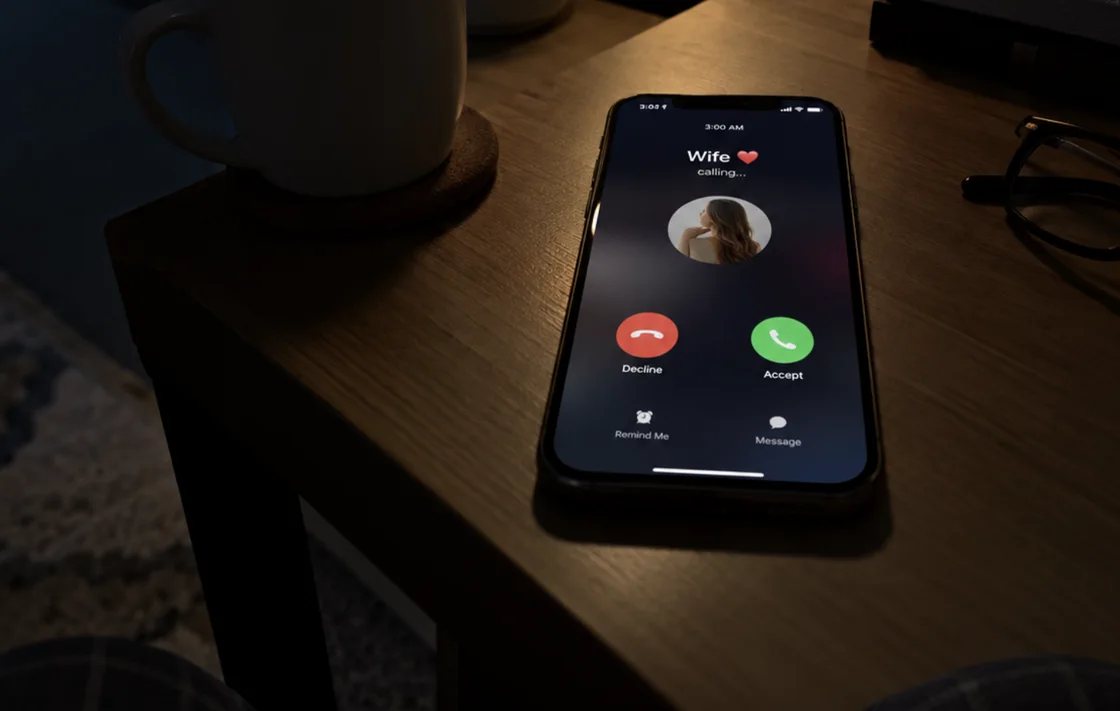
Your wife calls at 2 in the afternoon. You might answer or call back later.
But if she calls at 3 in the morning, you’d probably pick up immediately. Something might be wrong.
Same person. Same call. Yet you react differently because you understand the situation.
We make these judgments all the time. But can an AI agent do the same? When should it interrupt us, and when should it stay quiet?
01
Where it started
I was designing an AI-first contract tool. The agent reads agreements, connects clauses to amendments and invoices, and identifies things people might need to act on.
Imagine opening the tool in the morning to find 200 AI-generated insights.
200 insights by morning. A person can act on a handful.
You’d still have to read through everything to work out what matters. We’d simply replaced reading contracts with reading AI.
Showing only the top five seemed reasonable. But important isn’t always urgent. One finding can wait three months. Another might affect a payment going out in fifteen minutes.
The question wasn’t just what to show. It was when, to whom, and how loudly.
02
Same finding, different urgency
At 9 AM, the agent reads Acme’s payment term as Net 60. At 11 AM, an amendment arrives changing it to Net 45. Now consider two situations.
9:00Payment term: Net 60
11:00Amendment 3 arrives. Payment term: Net 45
Payment is three months awayQuietUpdate the term quietly. Keep the evidence. No need to interrupt anyone.
Finance is paying at noon using the old termInterruptShow the change before the payment goes out.
The finding hasn’t changed. What changed is how much attention it deserves.
Decision 1. Urgency depends on the situation, not just the finding.
03
What should the agent do?
This made me question whether changing the appearance of an alert was enough. Sometimes the agent should simply update information. Sometimes it needs to interrupt. And sometimes it should ask, or stop warning once the issue is handled.
I explored four responses to the same finding.
The findingAmendment 3 changes Acme’s payment term from Net 60 to Net 45.
QuietNothing needs attention yet. Next payment is three months away.
Payment termNet 45Updated at 11:02 from Amendment 3.
InterruptSomeone is about to act. A payment is being processed at noon.
Today’s payment to Acme uses Net 60. Amendment 3 changed it to Net 45.
Review before payingAlready handled
AskSomething important is missing. The agent can’t see when the next payment is due.
Is a payment to Acme planned this week? The term changed to Net 45, but I can’t see your payment schedule.
Yes, this weekNoNot mine
After a person responds
AdaptSomeone has already handled it. Finance confirms the change is taken care of.
Handled by FinanceWon’t raise this again unless the payment details change.
These aren’t just four ways of displaying an alert. They’re four different things the agent can do.
But there’s a catch. Asking also takes time. If a payment is going out in fifteen minutes, waiting for an answer may be worse than interrupting.
04
When the agent gets it wrong
Consider two contracts.
Contract A
Expires in two days. The vendor is already being offboarded.
Contract B
Expires in ten days. The renewal needs a decision this week.
By date A firstBy situation B first
Sort by date and Contract A comes first. But anyone who knows the situation would prioritise B. The agent could read every document correctly and still get the priority wrong.
I initially thought more context might solve this. But an agent can know 99 things about a contract and still miss the one fact that matters: Finance is paying at noon.
Knows 99 things
Missing: payment at noon
Stays quiet. Wrong call.
Knows 3 things
Payment at noon
Net 45 amendment
Finance owns it
Interrupts. Better-informed call.
Some facts may never reach the system. A renewal agreed over the phone. A supplier replaced after a meeting. An issue someone has already resolved.
The agent needs to be clear about what it knows and make it easy for people to correct it. “We’re already on it” isn’t just dismissing an alert. It’s giving the agent information it didn’t have.
Decision 2. More context doesn’t always mean better judgment. What matters is the fact that could change the decision.
05
What the agent needs to consider
These examples helped me narrow the problem to four questions.
FindingAn amendment changes the payment term
→
ConsequenceWhat happens if this is missed? Can it be undone?
TimeWhen does it start to matter?
Enough to judgeIs the information needed to make the decision missing?
PeopleWho owns the decision? Has someone already acted?
→
ResponseQuietSurfaceAskInterrupt
↺ When a person responds, that answer becomes part of the context for the next decision.
Together, these shape whether the agent stays quiet, shows something, asks, or interrupts.
Earlier, I’d explored five levels of attention, from Nothing to Interrupt. I still find them useful, but my thinking has shifted. The level of attention is the outcome. The harder problem is deciding which response the situation deserves.
06
What testing changed
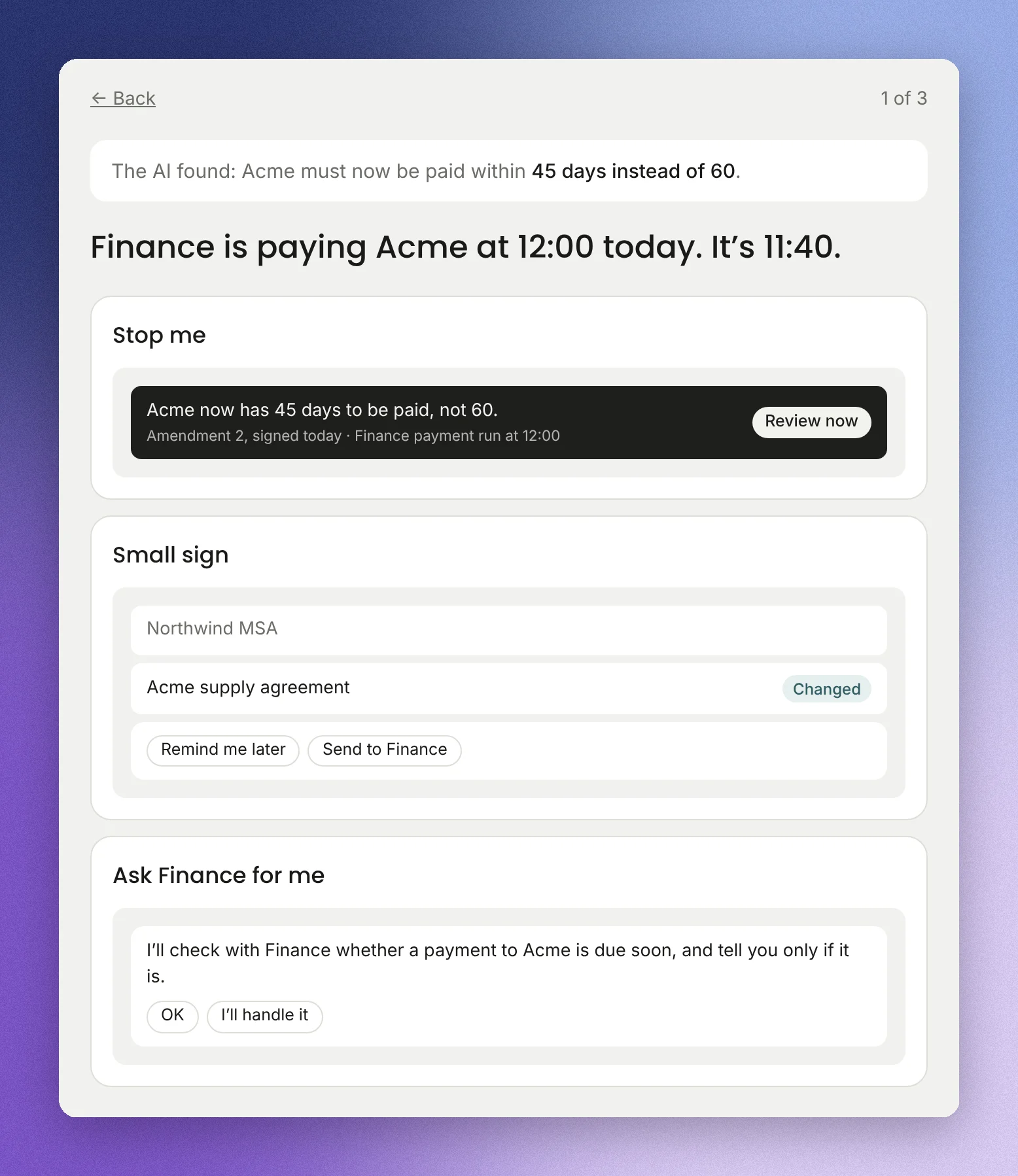
I built a small clickable prototype around the Net 60 to Net 45 change. People saw three situations: a payment going out at noon, one in three weeks, and one where the payment date was unknown. For each, they chose whether the AI should interrupt, show a small sign, or ask a question.
Seven people tried it across two rounds, about two minutes each.
What people saw in round two, for the noon-today moment.
I expected the urgent payment to trigger an interruption, the distant one to stay quiet, and the unknown date to trigger a question. The first two went as expected. The third surprised me.
Nobody wanted the AI asking them when Finance would pay. They didn’t know. Finance did.
I’d been thinking about missing information without considering who could actually provide it. That changed the design.
BeforeAsk the user
→
What I learnedThe user may not know
→
AfterAsk Finance for me
Testing also revealed two other things
Show the proof. People wanted to see the contract text before trusting an urgent warning.
Let people return later. A quiet notification needed a “Remind me later” option.
Decision 3. Knowing who owns the decision matters as much as knowing how urgent it is.
This was a small test, and I didn’t record participants’ roles. These are early design directions, not validated rules.
But one thing stayed with me.
I had designed for missing information without asking who could supply it.
What’s different now is that AI agents can find hundreds of things on their own, across documents and systems. But finding something doesn’t mean knowing what someone should do about it.
The agent may know a payment term changed. It may not know Finance already handled it. It may know a contract is expiring. It may not know the supplier is being replaced.
The agent can be right about what it found and still be wrong about what matters. That’s the part I’m interested in designing for.
How can an agent decide when something deserves our attention, especially when the most important part of the situation might be something it doesn’t know?
A way for an agent to judge what a moment means for the person in front of it,
decide how much attention that deserves, then spend no more than that.
Attention is the budget. Space and time are how it gets spent.
Space is how much is present at once. Time is the same place, used again
at a later moment. Most interfaces only know how to spend space.
01 · Attention
How much attention is the interface allowed to take?
Let the reader notice something new is there.
The level is set by what it would cost this person, in this situation, to miss
the change, not by how certain the system is that it found one.
02 · Expression
Four ways to spend the allowance. Two spend time, which is the
reader’s. Two spend space, which is the page’s.
spends time
The value is replaced in place by what comes next.
Extended from Net 30 by Schedule 2 on renewal.
Payment terms
Net 45
Extended from Net 30 by Schedule 2 on renewal.
←Schedule 2
Extended from Net 30 by Schedule 2 on renewal.
Time can stand in for space only when the earlier information has
finished its job. Where the two need to be compared, replacing one with the other
saves pixels and spends memory.
03 · Source
Where did the new information come from?
Already in the system before anyone asked.
Generated information can take time, be uncertain, need correction, and be wrong.
04 · The same moment, twice
Three moments from the page above. Beside each, the answer most
software gives, and the one it was given here.
Counter the renewal at +6%
Send the counter-offer at +6%?
Counter the renewal at +6%
Their ask sits above comparable renewals and usage is low.Vendor requested +12%, submitted 4 March. Comparable renewals in segment: +5.4% median, n=38. Seat utilisation 61% trailing 90 days, down from 78%.
Vendor requested +12%, submitted 4 March. Comparable renewals in segment: +5.4% median, n=38. Seat utilisation 61% trailing 90 days, down from 78%. Prior renewal +9%, accepted without counter. Contract permits 30-day notice. Three similar accounts countered at +6%, +5%, +7%. Model confidence 0.81. Suggested next step: draft counter. Alternative: request usage-based tier. Related obligations: 2. Escalation path: category lead.
Send summary to 42 customers
drafted from this week’s activity
Sent to 42 customers
It goes at 4:00 PM and cannot be recalled after that.
EMEA18Americas15APAC9
Shipped · 12in the digest, in merge orderMoved · 3re-dated to Thursday next weekBlocked · 1the SSO migration, waiting on the vendor
Notice period · 90 days
90 daysin force since 31 March 2026 · Amendment No. 3
60 days2 February 2024 to 31 March 2026 · Amendment No. 2
45 days31 January 2019 to 2 February 2024 · Amendment No. 1
30 daysas signed, 31 January 2018 · Master Services Agreement
Amendment No. 3 · Renewal & Terms1 of 4
“Either party may terminate this Agreement, in whole or in part,
for convenience on ninety (90)
daysprior written notice to the other party.
Termination under this Section does not relieve either party of any obligation
accrued before the effective date of termination.”
§14.1 · 31 March 2026
Choose the least expensive interaction that gives the moment enough
attention.